 Tutorials
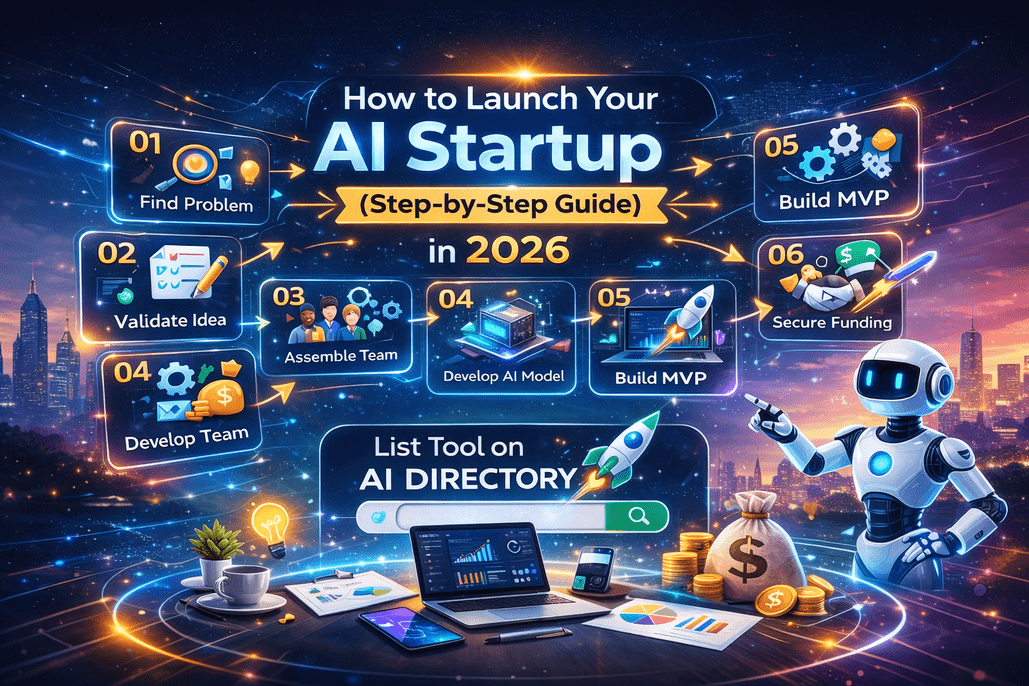
How to Launch Your AI Startup in 2026 (Step-by-Step Guide)
February 25, 2026 · 3 min read
Artificial Intelligence is one of the fastest-growing industries in the world. In 2026, launching an AI startup is no longer limited to large tech companies. With open-source models, APIs, and no-code tools, founders can build and scale AI products faster than ever.
If you're planning to start an AI business, this step-by-step guide will walk you through the exact process — from idea to launch and growth.
Why 2026 Is the Best Time to Start an AI Startup
The AI market continues to expand across industries like healthcare, marketing, finance, education, and eCommerce. Businesses are actively searching for:
- AI automation tools
- AI agents and chatbots
- AI productivity software
- AI marketing solutions
- AI analytics platforms
Demand is growing — and so is opportunity.
Step 1: Identify a Real Problem to Solve
The best AI startups solve clear, expensive problems.
Ask yourself:
- What task do businesses repeat daily?
- Where are companies wasting time or money?
- Which industry lacks automation?
💡 Tip: Focus on niche problems instead of building “another general AI tool.”
Example niches:
- AI for real estate agents
- AI for HR recruitment
- AI for legal document review
- AI for Shopify store owners
Specific beats generic.
Step 2: Validate Your AI Startup Idea
Before building anything:
- Talk to potential customers
- Run surveys or interviews
- Post in relevant communities
- Create a simple landing page
Measure:
- Are people interested?
- Would they pay?
- What features matter most?
Validation prevents wasting months on the wrong product.
Step 3: Choose Your AI Tech Stack
In 2026, you don’t need to train your own model from scratch.
You can build using:
- AI APIs (LLMs, image models, speech models)
- Open-source AI frameworks
- No-code AI builders
- Cloud infrastructure (AWS, GCP, Azure)
Focus on solving the user problem — not reinventing the model.
Step 4: Build a Minimum Viable Product (MVP)
Your MVP should:
- Solve one core problem
- Be simple and usable
- Deliver immediate value
Avoid feature overload.
Launch fast. Improve later.
Step 5: Design a Strong Monetization Model
Popular AI startup pricing models include:
- Monthly subscription (SaaS)
- Usage-based pricing
- Credit systems
- Freemium with upgrades
- Enterprise plans
Choose pricing based on your target market.
Small businesses prefer predictable pricing. Enterprises expect customization.
Step 6: Focus on User Experience (UX)
Many AI tools fail not because of weak AI — but poor usability.
Make sure:
- The interface is clean
- The onboarding is simple
- The AI responses are clear
- The value is obvious within minutes
Good UX increases retention and referrals.
Step 7: Launch & Distribute Your AI Tool
Building is only half the battle. Distribution wins.
Launch strategies:
- Submit to AI directories
- Post on Product Hunt
- Share in founder communities
- Run targeted ads
- Publish SEO blog content
💡 Listing your tool on AI directories helps founders gain visibility, backlinks, and early users.
Step 8: Collect Feedback & Improve
After launch:
- Monitor usage data
- Track churn rate
- Ask users for feedback
- Improve based on real behavior
AI startups grow by iteration.
Step 9: Scale With Automation & Marketing
Once validated:
- Automate onboarding emails
- Build affiliate programs
- Publish SEO content
- Partner with other SaaS tools
- Invest in paid ads
Growth should become systematic — not random.
Common Mistakes AI Founders Make
❌ Building before validating
❌ Overcomplicating features
❌ Ignoring marketing
❌ Targeting everyone instead of a niche
❌ Underpricing advanced AI tools
Avoid these mistakes and your success rate increases dramatically.
Final Thoughts: The AI Opportunity Is Still Early
AI is transforming industries — but we are still early in adoption.
The biggest winners in 2026 won’t be the companies with the most advanced AI.
They will be the ones that:
- Solve clear problems
- Focus on specific users
- Launch fast
- Improve continuously
If you’re building an AI tool, now is the time to take action.
Ready to Launch?
Once your AI startup is live, make sure people can discover it.
List your AI tool, showcase features, and get discovered by entrepreneurs, marketers, and businesses actively searching for AI solutions.
The future of AI belongs to builders. Start today.